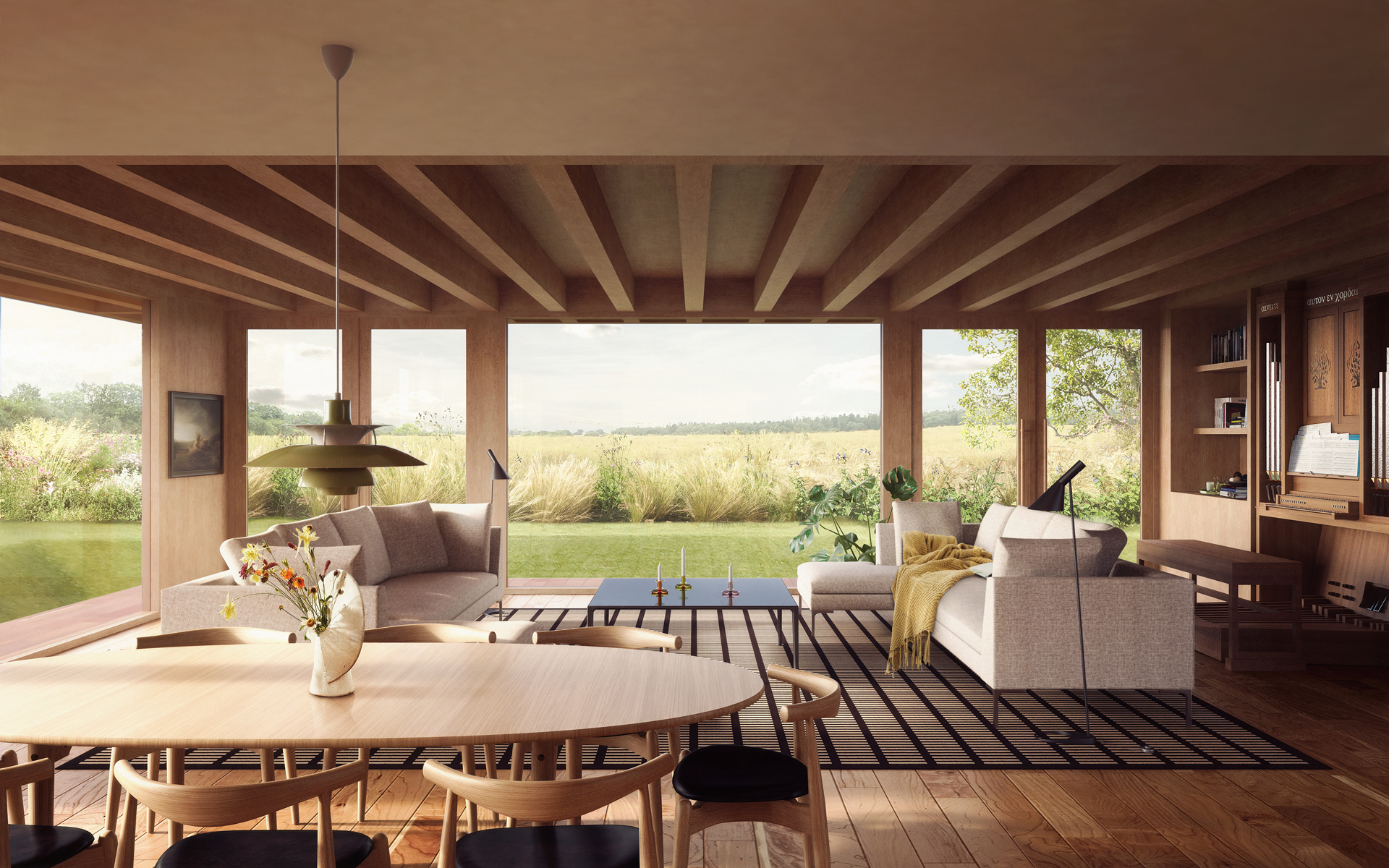
17th Century Farmhouse Retrofit
Passive House Enerphit Plus extension & retrofit of 17th Century Listed farmhouse
This project demonstrates the potential for retrofitting of hard-to-heat heritage buildings using ecological, vapour permeable and ‘breathable’ materials. The retrofitted house is warm in winter and cool in summer (Photographs of completed house coming soon)
Despite being a striking combination of the old and the ultra-modern, the project was supported by planning and conservation officers due to the proposal to remove some bulky 20th century additions, together with the reinstatement of historic horizontal sliding sash windows and the proposed use of natural materials favoured by heritage groups.
Externally, we have reinstated the architectural hierarchy of the original 17th century Listed hall house and created a new entrance bridge and forecourt. Through historical research we also identified and reinstated the form of a lower, 18th century ‘catslide’ roof extension. The new single-storey wing is designed to appear subservient to the historic house, but inside, the new wing has surprisingly tall internal spaces, over 2.5m high, due to the requirement to house a 20th century church organ. However, from the outside, no clue is given of the height of the internal spaces in the new wing.
The project demonstrates that sensitively designed retrofits of historic buildings can achieve all the Passive House Plus advantages including superb indoor comfort in both summer and winter, and provide optimal air quality, all while needing only a vanishingly small amount of energy from the electricity grid.
So far in its first year, this all-electric house produced more electricity (10.2 MWh) than it consumed (9.69 MWh), even while charging two electric cars in heavy daily use for short and long journeys.
Comfort was maintained even on the hottest day of the year in 2026. Internal air temperatures throughout the new wing, despite its huge windows, remained below 25 degrees during the heatwave, with no need for air conditioning even when external temperatures approached 40 degrees Celsius. Even in the historic wing the temperature never reached 26 degrees during the 38-degree heatwave.
We enhanced the beauty of the historic building using sympathetic, research-based design skills and we worked collaboratively with the contractor who followed our details meticulously, resulting in the extraordinary Passive House airtightness test result of 0.4 ac/h @ 50pa.
It will require a mindset shift across the construction industry to achieve high-performance retrofits such as this across the country. Without expert leadership there are many potential pitfalls and at present the necessary design and construction skills are hard for people to find.
The UK has some of the oldest housing stock in Europe and it is unprepared for what lies ahead. Unimproved homes leave people unprotected from extreme weather events such as this summer’s heatwaves and cold winters. Too often, owners of heritage buildings are told that they can only upgrade their heating or install air conditioning. Such advice might be well-intentioned but is wrong. Short term fixes like that are a waste of money and simply pass long-term problems on to others in the future.
This project demonstrates that heritage buildings can, in the right hands, be adapted, improved, and made beautiful again through a deep retrofit approach. It is possible to improve historic buildings so that they protect their occupants in the long term from the effects and costs of climate change.